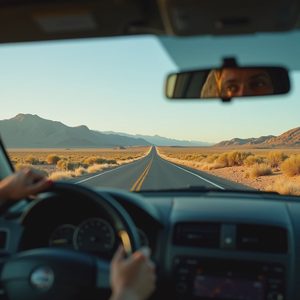
The rearview mirror is the most underused teacher in the car. It is consulted in quick glances — a check for traffic, a confirmation that the lane is clear — but rarely studied for anything beyond the practical. This makes sense. The road ahead demands most of your attention, and the mirror, by design, shows you where you have already been.
But after 200 miles, something changes. The mirror stops being just a safety device and becomes something closer to a companion. It holds the landscape you are leaving behind. It frames the sky behind you, which is often a different color than the sky ahead. It catches the small details that the forward view misses — the truck that just pulled onto the highway behind you, the storm you outran, the mountain pass that is now just a blue shape receding into distance.
I have spent enough hours alone in a car to notice that the rearview mirror teaches things the windshield cannot. Here are a few of them.
The view behind is sometimes better than the view ahead
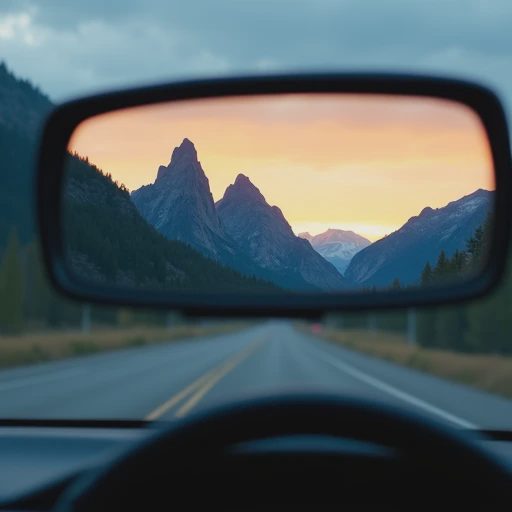
This is not a metaphor, though it could be. It is a literal truth that I have encountered on dozens of drives. The road ahead might be flat and unremarkable — a straight line through plains or a stretch of featureless highway — while the view behind is filling with something spectacular.
I drove east across Kansas once, leaving the Rockies in the rearview mirror. For the first hundred miles, the mountains dominated the reflection. They shrank slowly, turning from jagged peaks to a dark line to a memory of a shape, but for those hundred miles, every glance in the mirror gave me something the windshield could not. The road ahead was just road. The road behind was a farewell.
On another drive, heading south through the San Luis Valley, a thunderstorm built behind me over the Sangre de Cristos. The forward view was clear blue sky and afternoon sun. The mirror was purple clouds and distant lightning. I adjusted the mirror slightly to keep the storm in frame, watching it gather over mountains I had crossed hours earlier. The drive felt richer for having both views — the calm ahead and the drama behind.
If you only remember one thing
Check the rearview mirror for beauty, not just for cars. You might be driving away from the best part of the view.
What the mirror shows you about your own packing
On a solo trip, the rearview mirror frames the interior of the car behind you. The back seat. The cargo area. The things you brought with you.
After 200 miles, you start to notice what is back there. The bag that shifted on a sharp turn and is now leaning at an angle. The jacket you brought just in case and haven't touched. The empty passenger seat, which you arranged carefully before leaving and haven't looked at since. The mirror, in its quiet way, takes inventory. It shows you what you are carrying — not just in terms of objects, but in terms of the decisions you made before you left.
I have learned things from the mirror's inventory. That I packed too much, again. That the bag I thought I needed is still zipped shut. That the car feels more spacious and more peaceful when the back seat is empty. The mirror doesn't judge. It just reflects. But the reflection, over enough miles, starts to feel like a gentle audit of your choices.
The rhythm of headlights appearing and disappearing
Driving at dusk changes the role of the mirror. The light is fading, and the cars behind you become visible as headlights before they become visible as vehicles. The mirror fills with small points of light that grow larger and then swing out to pass or settle into the lane behind you.
There is a rhythm to this. A pair of headlights appears on the horizon behind you. They stay small for a long time, then grow steadily. Eventually they are close enough that you can see the shape of the vehicle around them. Then they pass, or you move over, and the mirror goes dark again. A few minutes later, the cycle repeats.
I have driven enough dusk highways to find this rhythm comforting. It is a reminder that you are not alone on the road, even when the forward view is empty. The mirror connects you to the travelers behind you — people you will probably never meet, heading somewhere you will probably never go, sharing the same stretch of highway for a few minutes before the distance between you grows again.
What I'd do differently next time
Pay more attention to the cars that stay behind me for a long time without passing. There is something companionable about a stranger who matches your speed for fifty miles. The mirror lets you travel together without either of you having to acknowledge it.
The moment you stop checking it
There is a point on a long drive, usually after the first hundred miles, when the rearview mirror becomes less important. The traffic thins. The highway straightens. The world behind you settles into a steady, unchanging background.
When that happens, the mirror stops being a tool and becomes something closer to a frame. It holds a fixed image — the same stretch of road, the same slice of sky, the same distant mountains or plains or clouds — for miles at a time. You glance at it less often, but when you do, the image is almost identical to the last time you looked. This constancy is not boring. It is grounding. The mirror becomes a reminder that some things do not change quickly. The landscape moves at its own pace. The road behind you is patient.
I have caught myself, on very long drives, talking to the mirror. Not out loud. But thinking toward it, as if the fixed image in the glass were a listener. The road behind you has seen everything you just drove through. It knows where you have been, even when the forward view is uncertain. That sounds more poetic than a mirror deserves. But after 200 miles, poetry is what the road provides.
What the mirror cannot show you
The rearview mirror has limits. It cannot show you what is coming around the next curve. It cannot tell you whether the diner in the next town is any good. It cannot warn you about the weather fifty miles ahead. It is, by design, backward-looking.
That limitation is also its wisdom. The mirror does not pretend to know the future. It only knows where you have been, and it reports that information faithfully, without commentary. There is something to learn from that restraint. The road ahead demands constant attention and constant decisions. The road behind asks for nothing except an occasional glance and the quiet acknowledgment that it is still there, receding, carrying the miles you have already traveled.
After 200 miles, the rearview mirror teaches you that the past is not something to stare at. It is something to check, briefly, with gratitude and a little bit of wonder, before returning your eyes to the road ahead. The view behind is beautiful. But the view ahead is where the rest of the drive lives.
Letters
No letters yet — be the first to write.