A long drive expands to fill the time you give it. Five hours can feel like eight if the road is monotonous and your attention has nowhere to land. The same five hours can feel like three if the drive is broken into pieces — small moments that mark the passage of miles without asking much of you.
The difference is not in the distance or the speed. It is in the rituals. The small, repeatable actions that give the drive a rhythm. The things you do not because you have to, but because they make the time feel less like a stretch of endurance and more like a series of small arrivals.
I have collected a handful of these rituals over the years. None of them are complicated. Most of them would seem insignificant to anyone watching from the passenger seat. But together, they turn a long drive into something I look forward to rather than something I just get through.
The first-hour rule: settle in before you push on
The first hour of a long drive is not for making good time. It is for settling into the trip. I used to treat the opening miles as a race — merge onto the highway, set the cruise control, start eating up distance. The sooner I covered ground, the sooner I would arrive.
What I learned is that rushing the first hour makes the rest of the drive feel longer. The body stays tense. The mind stays in departure mode. The trip feels like a task to complete rather than an experience to inhabit.
Now I use the first hour differently. I find a comfortable position and adjust it slowly over the first thirty miles — a slight recline here, a lumbar tweak there. I choose music or silence depending on the mood, not the expectation. I let the car warm up fully and the fluids circulate and the tires settle into their highway rhythm. I don't check the clock. I don't calculate the estimated arrival time. I just drive, and let the road do the work of pulling me into the journey.
If you only remember one thing
The first hour sets the tone for everything that follows. Don't rush it. Let the trip begin before you start measuring it.
The hourly stretch that takes sixty seconds
This ritual is so simple that it barely deserves a name. Once an hour, give or take, I do a small stretch without leaving the driver's seat. I roll my shoulders back and down. I tilt my head side to side. I flex my ankles and point my toes against the floor mat. I grip the steering wheel at different positions — ten and two, then eight and four, then one hand at six — just to change the muscle pattern.
The whole thing takes about a minute. It doesn't replace a proper rest stop, and it is not meant to. It is meant to interrupt the slow stiffening that happens when you hold one position for too long. The body doesn't need a full break every hour. It just needs a reminder that it is allowed to move.
I started doing this after a drive to Moab where I arrived with a knot between my shoulder blades that took two days to release. The knot was not from an injury. It was from holding the exact same posture for five hours without a single variation. The hourly stretch is my quiet rebellion against that kind of unnecessary fatigue.
The midpoint coffee that means more than caffeine
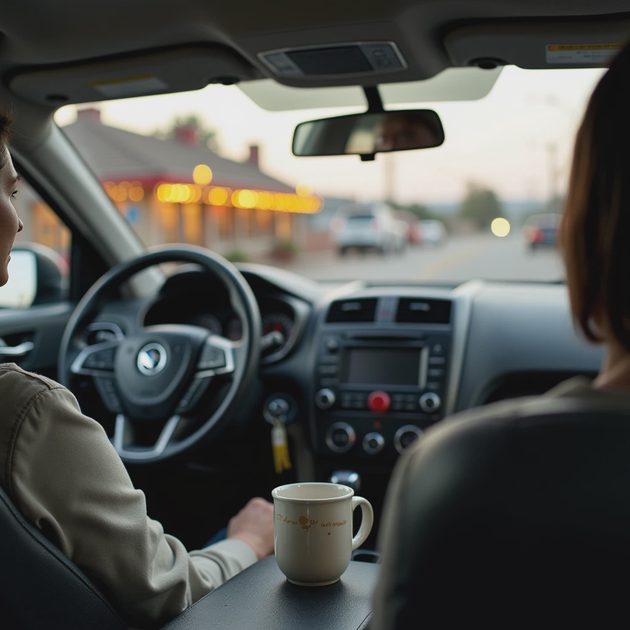
Somewhere around the middle of a long drive, I stop for coffee. Not a drive-thru coffee. Not a coffee grabbed at a gas station while the pump runs. A real stop — fifteen or twenty minutes, inside a diner or a cafe, sitting at a counter or a table. Coffee that comes in a ceramic mug, even if the mug has a chip in the rim.
The caffeine is not the point, though it helps. The point is the pause itself. A long drive has a shape, and the midpoint is the fulcrum. Everything before it is the outward journey. Everything after it is the return. Stopping at the midpoint marks that transition. It creates a small memory in the middle of the drive that makes the second half feel like its own experience rather than just more miles.
I have a mental map of midpoint coffee stops within a few hours of Denver. The diner in Fairplay with the breakfast burritos. The cafe in Salida with the mismatched chairs. The bakery in Westcliffe that opens early and sells out by noon. Each one is a small destination that breaks the drive into two manageable pieces, neither of which feels overwhelming on its own.
What I'd do differently next time
Order the pie. I never order the pie at these midpoint stops because I tell myself I don't need it. I always regret not ordering the pie.
The final hour silence
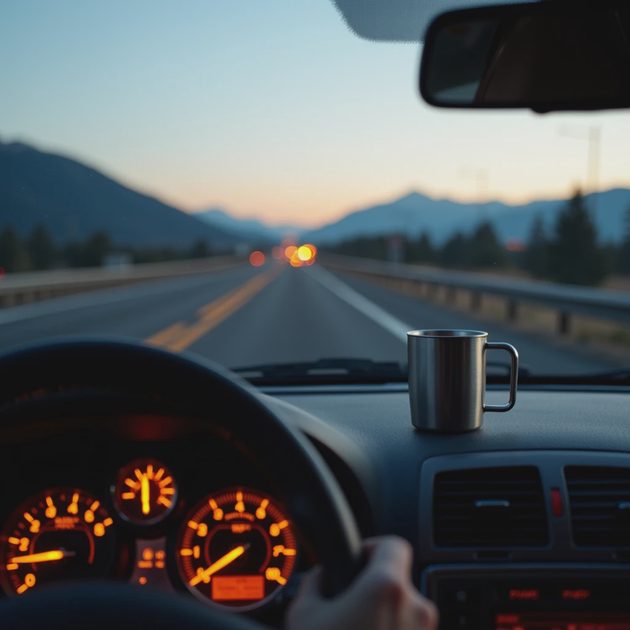
The last hour of a long drive is different from the rest. The destination is close enough to feel real. The fatigue is present but manageable. The light is usually lower, the shadows longer. There is a natural winding-down that happens whether you encourage it or not.
I have a ritual for this final stretch. I turn off the music. I turn off the podcast. I roll the windows up and let the cabin go quiet. For the last sixty miles or so, the only sounds are the road, the engine, and the small creaks of a car that has been moving for hours.
That silence does something I cannot fully explain. It processes the drive. It sorts through the images and the thoughts that accumulated over the previous hours and lets them settle into something like memory. The final hour in silence turns a long drive from a physical experience into a mental one. By the time I arrive, the trip feels complete — not just over, but finished in a way that music or conversation would have interrupted.
The arrival ritual that closes the trip
A long drive doesn't end when you turn off the engine. It ends when you mark the arrival. For me, that marking is a small ritual that takes about two minutes.
I park the car. I turn off the ignition. I sit in the driver's seat for a full breath — in and out, once, slowly — before opening the door. Then I walk around the car once, checking the tires, glancing at the windshield, noting the bugs that will need to be cleaned off later. It is not a mechanical inspection. It is a thank-you. The car carried me across hundreds of miles without complaint, and the least I can do is acknowledge that before I walk away.
Inside, I unpack the essentials first — the water bottle, the phone, the jacket — and leave the rest for later. The unpacking can wait. The arrival is for being still, briefly, in the place the car delivered me to. That stillness, after hundreds of miles of motion, is its own kind of ritual. It says: you are here now. The drive is done. It was good.
Why rituals work better than distractions
Distractions make a long drive feel shorter by pulling your attention away from the road. Music you sing along to. Podcasts that absorb your thoughts. Conversations that fill the cabin. These things have their place, and I use all of them.
But rituals are different. They don't pull your attention away from the drive. They deepen your attention to it. They give the miles a rhythm, a shape, a series of small landmarks that aren't on any map. The hourly stretch. The midpoint coffee. The final hour silence. The arrival walk-around. Each one is a small act of presence that keeps you connected to the experience instead of just waiting for it to end.
The part nobody tells you about long drives is that the time doesn't actually change. Five hours is five hours. What changes is how closely you are living inside those hours. Rituals bring you closer. And when you are close to the experience — really inside it, not just enduring it — the time moves differently. It moves the way time moves when you are doing something you love. Which is to say, almost without you noticing it.


Letters
No letters yet — be the first to write.