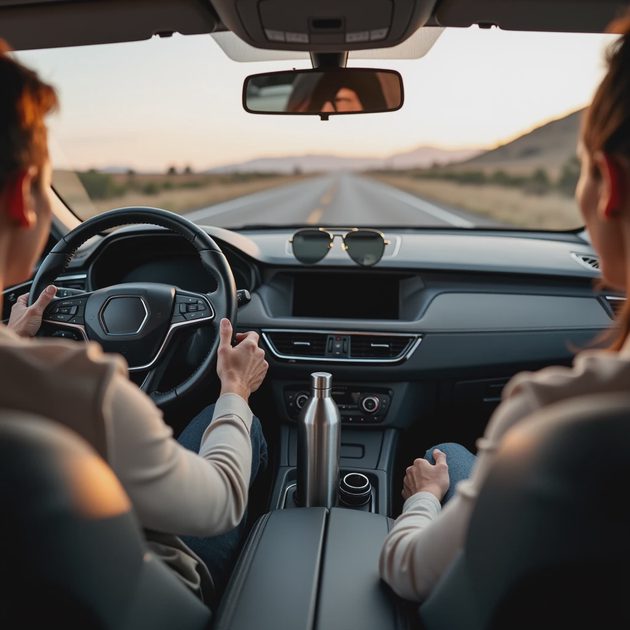
Long drives are not supposed to be effortless. There is a baseline of fatigue that comes with sitting in one position for hours, watching the road unspool, managing the small decisions of speed and lane and distance. That fatigue is not something you can eliminate entirely, and I have stopped trying.
What you can do is reduce the unnecessary tiredness. The kind that comes not from the driving itself but from small, fixable irritations that stack up mile after mile. The seat position that is almost right but not quite. The glare that hits the mirror at a certain angle. The noise that hums just loud enough to keep your shoulders tight without you noticing.
These five things have made a measurable difference for me. None of them are expensive. Most of them are free. All of them took me too long to figure out.
Adjust the seat for the long haul, not the driveway
I used to set my seat position based on what felt good pulling out of the garage. That position — upright, close to the wheel, engaged — works fine for a twenty-minute commute. It does not work for a five-hour drive.
The problem is that a short-drive seating position keeps your muscles slightly engaged, as if you are about to make a quick maneuver at any moment. That constant low-level tension drains energy in ways you don't feel until hour three, when your lower back starts asking questions and your shoulders have crept up toward your ears.
Now I set the seat for the highway. I move it back slightly, recline the backrest just a degree or two more than I think I need, and adjust the lumbar support so the curve of the seat matches the curve of my spine. The steering wheel comes with me — I adjust the reach so my wrists rest comfortably on the top of the wheel with my shoulders still touching the seat. The position feels almost too relaxed at first. That slight discomfort of "too relaxed" is the signal that I have found the right spot.
If you only remember one thing
Set your seat for hour three, not minute three. Your body will thank you long before the destination appears.
Manage the light before it manages you
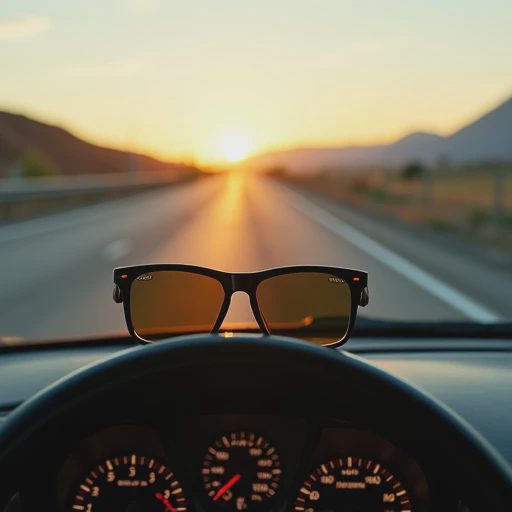
Eye strain on a long drive comes from contrast. Bright sky, dark dashboard, glare off the hood, reflections in the side mirror. Your eyes are constantly adjusting between different brightness levels, and that adjusting is work.
I do three things to reduce the strain. First, I wear polarized sunglasses even when the sun is not directly in my eyes. The polarization cuts the reflected glare off other cars and the road surface, which makes the whole visual field feel calmer. Second, I dim the dashboard lights slightly below what seems reasonable. A bright instrument cluster keeps your pupils smaller than they should be for the dark road ahead, and that mismatch adds fatigue. Third, I clean the inside of the windshield before a long trip. The film that builds up over weeks of daily driving catches light and scatters it in ways that make everything slightly harder to see.
None of these things cost money beyond a bottle of glass cleaner and a decent pair of sunglasses. Together, they make the visual experience of driving feel less like a sustained effort.
Take breaks before you think you need them
I used to push through. The logic was always the same: I feel fine now, so I will keep driving until I don't feel fine, and then I will stop. The problem is that by the time you don't feel fine, fatigue has already set in and the stop needs to be longer to recover.
Now I stop on a schedule, not a feeling. Every two hours, sometimes a little less if the drive is demanding, I pull over. The stop doesn't need to be long. Five minutes standing on solid ground, walking a short loop, drinking water, looking at something that is not the road. The goal is to interrupt the buildup of fatigue before it accumulates enough to notice.
The part nobody tells you about this approach is that it makes the drive feel shorter. Five minutes stopped every two hours might seem like it adds time, but the refreshed attention you bring back to the wheel more than compensates. You arrive feeling like you drove less than you actually did.
What I'd do differently next time
I would stop even when I don't want to. The stops I resist are usually the ones I need most.
Control the sound in the cabin
Road noise is fatigue in disguise. You don't notice it consciously after a while, but your brain is still processing it — tire hum, wind rush, the drone of the engine at highway speed. That processing takes energy.
I don't drive a luxury car with acoustic glass and active noise cancellation. What I have is a Subaru Outback with a reasonable amount of highway noise and a few small strategies to manage it. I keep the windows up at speed. I close the sunroof shade on long highway stretches. I set the music or podcast volume just loud enough to hear clearly without competing with the road noise — if I have to turn it up to drown out the car, the combination of both sounds is more fatiguing than either alone.
Sometimes, for the last hour of a long drive, I turn everything off. No music. No podcast. Just the road and the quiet hum of the tires. That silence, after hours of managed sound, is restorative in a way I cannot fully explain.
Hydrate like it's part of the drive, not an afterthought
Dehydration makes everything harder. Reaction time slows. Attention drifts. The body feels heavier than it is. I learned this the hard way on a drive to Santa Fe where I drank nothing but coffee for the first four hours and arrived feeling like I had aged a decade.
Now I keep a full water bottle within reach — not in the back seat, not in a bag, but somewhere I can grab it without looking. I drink a small amount regularly rather than chugging at stops. This requires more bathroom breaks, and those bathroom breaks are secretly an advantage. They force the stop schedule that I should be following anyway. The water and the pause work together.
The bottle I use is a simple stainless steel one that I have written about before. It keeps water cold for hours, which makes me more likely to drink it. Warm water on a long drive is not appealing, and if the water is not appealing, I will not drink it. That small detail — the temperature of the water — has more impact on my hydration than any amount of willpower.
The difference between arriving and surviving
There is a version of a long drive where you arrive drained, shoulders tight, patience gone. And there is a version where you arrive tired in the normal way — ready to sit down, maybe, but not wrecked. The difference is not in the car. It is not in the distance. It is in the small choices made in the hours before the fatigue sets in.
None of these five things require discipline or money. They require a small shift in attention — toward your body, toward the cabin, toward the rhythm of the road. The drive will still be long. It will still ask something of you. But it doesn't need to ask more than necessary.


Letters
No letters yet — be the first to write.