I don't carry a fully stocked emergency kit. I know people who do — who have shovels and traction boards and first-aid supplies organized in labeled pouches — and I respect that approach. But for the kind of driving I do most weekends, a minimalist kit makes more sense. Something that covers the common problems without taking up half the cargo area. Something I can forget about until I need it, and then find exactly what I want in under thirty seconds.
This is the trunk kit I have refined over several years and countless trips. It lives in a collapsible fabric organizer behind the rear wheel well, and it has handled everything from a slow tire leak outside of Salida to a coffee spill that happened before I even left the driveway. Nothing in it is expensive. Most of it I bought once and have never replaced.
The container that holds everything
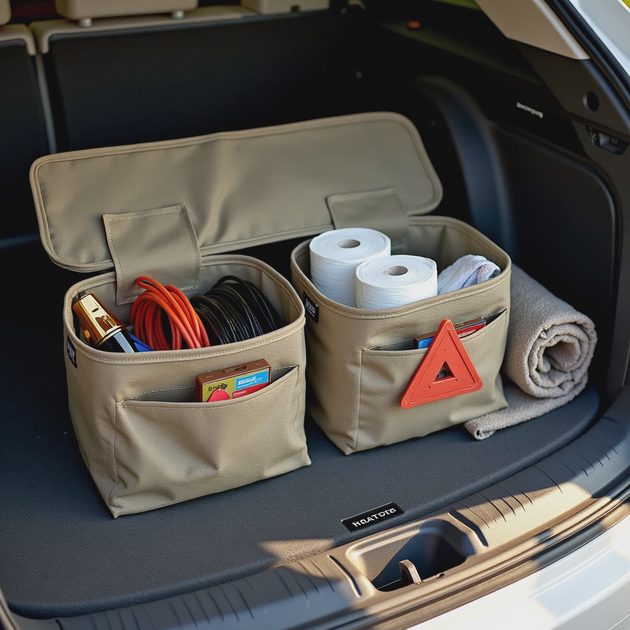
Before listing what is inside, I should mention what holds it. I use a fabric trunk organizer with two compartments and a set of Velcro strips on the bottom that grip the cargo mat. It cost maybe twenty dollars. It doesn't slide around on gravel roads, which matters more than you would think.
The two-compartment design turned out to be useful in a way I didn't anticipate. One side holds the emergency and utility items — the things I hope not to use. The other side holds the everyday mess items — the things I use more often than I would like to admit. The division means I can reach for a paper towel without unzipping a first-aid kit, and it means the emergency side stays organized because I rarely need to open it.
If you only remember one thing: The container matters almost as much as the contents. If it slides around or spills open on a turn, the kit will not stay organized for long.
The emergency side: what I hope not to use
This side opens maybe twice a year. It carries the basics, and nothing more.
There is a first-aid kit, but not the kind that comes prepackaged with two hundred items I will never touch. I built it myself in a small zippered pouch: adhesive bandages in a few sizes, antiseptic wipes, gauze pads, medical tape, tweezers, and a small tube of antibiotic ointment. I also keep a pair of nitrile gloves folded flat, because helping someone else with a cut is less stressful when you are not worried about what is on your hands.
There is a tire pressure gauge, the brass dial type I have written about before. There is a small LED flashlight with fresh batteries that I check before long trips. There is a set of jumper cables, the shortest and lightest pair I could find that still felt substantial. And there is a reflective warning triangle, folded flat, that I bought after sitting on the shoulder of I-25 with a flat tire and realizing other cars could not see me until they were too close for comfort.
That is the emergency side. It weighs maybe eight pounds total. It doesn't prepare me for every possible scenario — no kit does — but it covers the ones I have actually encountered in fifteen years of driving.
The messy day side: what I reach for more than I want to
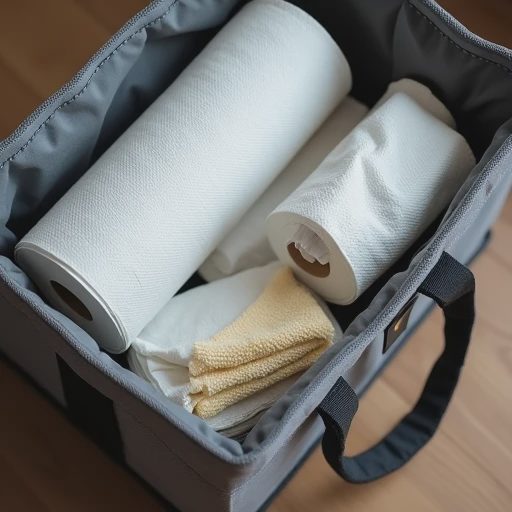
This side is less glamorous but more frequently used. It contains a roll of paper towels, a pack of unscented wet wipes, a small trash bag folded into a compact square, and a microfiber cloth.
The paper towels have handled spilled coffee on the center console, mud transferred from boots to the driver's seat, and once an entire container of salsa that opened itself in the cargo area. The wet wipes have cleaned hands after a roadside tire change and faces after a dusty hike. The microfiber cloth wipes down the touchscreen and the sunglasses and the inside of the windshield when the light hits it wrong.
These items are so simple that it almost feels silly to list them. But having them in a fixed location, reachable without digging, has solved more small problems than anything else in the car. The messes happen. The kit just makes them less of an event.
What I'd do differently next time
I would add a small spray bottle of water. Some messes need a little moisture to lift, and the wet wipes are not always enough. I have a tiny one now, repurposed from a travel toiletry set, and it lives in the messy side pocket.
The comfort items that earned their place
There are a few things in the kit that don't fit neatly into emergency or messy categories. They are just things that make difficult moments easier.
A wool blanket, folded tight, sits at the bottom of the organizer. I have used it at cold trailheads and as a picnic surface and once as an impromptu shade cloth draped over the rear window. A spare phone charger, the kind with a long cord, lives in one of the side pockets. My main charger stays in the cabin, but the backup has saved me twice — once when the primary cable frayed, and once when a passenger needed a charge and I didn't want to give up my own.
There is also a small notebook and a pen. Not for journaling. For writing down information when a phone dies or a signal disappears. I have used it exactly once, to copy directions from a gas station attendant when my phone lost service in a dead zone outside of Gunnison. That single use justified its presence for the next ten years.
What I don't carry, and why
A list of what is not in the kit might be as useful as what is. I don't carry a full tool set. I am not a mechanic, and the things I know how to fix on the side of the road are limited to what the kit already covers. A tool set I cannot use is just weight.
I don't carry food or water in the trunk kit itself. Those live in the cabin, within reach while driving. The trunk kit is for the unexpected. Water and snacks are for the expected, and I treat them differently.
I don't carry a blanket for every passenger or supplies for a multi-day survival scenario. That kind of preparation has its place for overlanding or remote expeditions. For a weekend drive within a few hours of home, it adds bulk that makes the kit harder to access and less likely to be maintained.
The kit as a habit, not a purchase
Here is the part nobody tells you about a trunk kit. The contents matter far less than the habit of maintaining it. A kit assembled once and forgotten for three years is not a kit. It is an archaeological record of the person you were when you put it together.
I check mine at the start of every season. I replace the flashlight batteries even if they still work. I restock the bandages if the pouch is running low. I refold the blanket and tuck it back into its spot. The whole process takes fifteen minutes, and it gives me a small sense of readiness that I carry into every trip.
A trunk kit is not a purchase. It is a practice. The gear is just the starting point.


Letters
No letters yet — be the first to write.