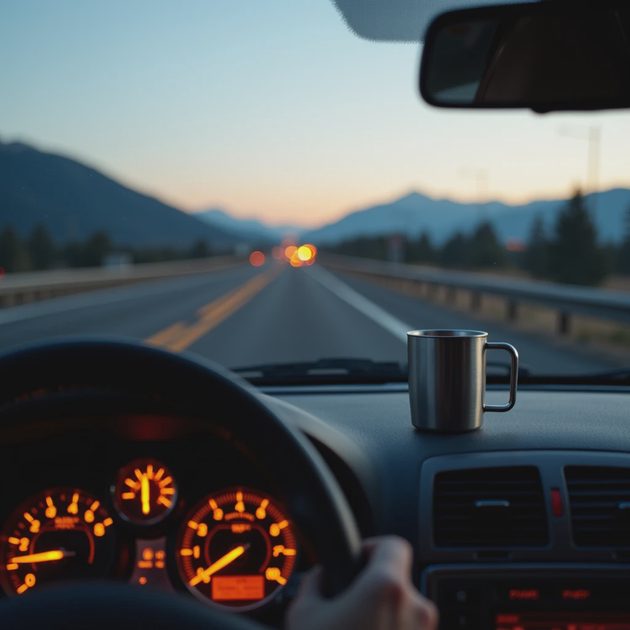
There is a version of Saturday that starts at 9 a.m. The sun is already up, the traffic is already building, and the gas station near the highway on-ramp already has a line. You haven't done anything wrong. You woke up at a reasonable hour, made coffee, packed the car without rushing. But by the time you merge onto the highway, the day already feels like it belongs to everyone else.
I have done that version many times. It is fine. It gets you where you are going.
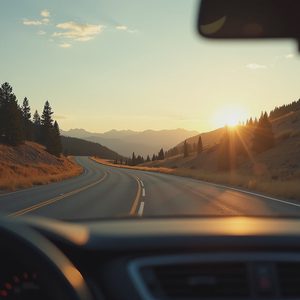
Then there is the other version. The one where the alarm goes off at 5:30 and you are on the road before the sun clears the horizon. The one where the highway is nearly empty and the light is still soft and the whole day stretches out ahead of you like unrolled pavement. That version does not just get you where you are going. It changes how the trip feels from the first mile.
I call it the Saturday morning window, and I have come to believe it is the single most important decision in planning a weekend drive.
The road before it fills up
The most obvious advantage of leaving early is the traffic, but the traffic is not really the point. An empty road is not just faster. It is qualitatively different. When you are the only car on a stretch of highway, the drive feels less like a commute and more like a conversation between you and the landscape. There is no one to pass. No one passing you. No brake lights pulsing red in the distance. Just the road, the engine note, and the quiet sense that you have stolen something the rest of the world hasn't woken up to claim yet.
I left Denver at 6:15 on a Saturday last October, heading west on I-70 toward the mountains. By the time I reached the foothills, the sun was just beginning to touch the highest peaks, turning them that pale pink that lasts for about eight minutes before the light shifts to full morning. I had the right lane to myself for nearly forty miles. Not metaphorically. I counted. Forty miles without another vehicle in sight ahead of me. That kind of solitude is not available at 9 a.m. It is gone by then, swallowed by the reasonable hour.
If you only remember one thing
The road is a different place before 7 a.m. It belongs to a smaller group of people, and they all understand why they are there.
The light that doesn't last
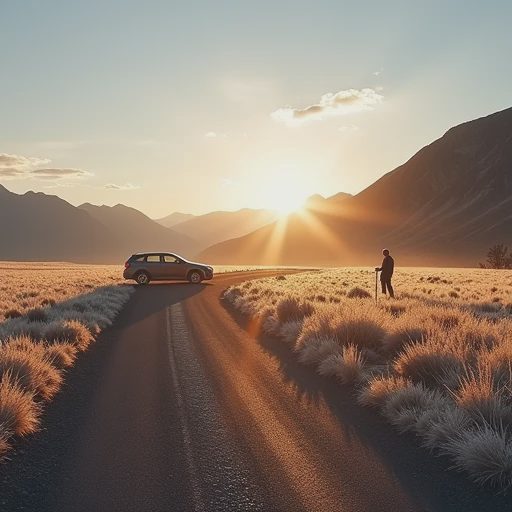
There is a kind of light that only exists in the first hour after sunrise. It is low and angled and slightly golden, and it makes ordinary landscapes look like they are keeping a secret. Highway 285 south of Denver is not particularly scenic in the flat light of midday. But at 7 a.m. in late September, with the sun rising over the plains to the east, the grasslands glow in shades of amber and wheat that disappear by 9.
I have a distinct memory of driving through South Park just as the sun cleared the horizon. The basin was covered in frost, and the low light turned every blade of grass into something that looked lit from within. I pulled over at a turnout that I had driven past a dozen times before and never noticed. Not because the turnout was hidden — it wasn't — but because the light had never made it look like the only place worth stopping. By 8:30, when I passed back through on the return drive, the frost was gone and the turnout looked ordinary again.
The part nobody tells you about early morning light is that it is a limited resource. You cannot schedule it for later. It arrives on time and it leaves without waiting, and if you are still in bed, you miss it. That is not a judgment. It is just a fact.
The quiet in your own head
The practical benefits of leaving early are easy to list. Less traffic, better light, cooler temperatures in the summer. But the reason I keep doing it is harder to explain. It has to do with the inside of my own head.
At 6 a.m., my brain is not yet fully online in the way it will be by 9. The internal noise is lower. The checklist of things I should be doing — work tasks, household errands, emails I haven't answered — hasn't fully loaded. I am operating on instinct and coffee, and that combination turns out to be ideal for noticing things. The shape of a cloud. The way the road curves around a ridge. The sound of gravel under the tires at a pullout.
Later in the day, those same things are still there, but I am less present for them. The mental static has increased. The drive becomes something I am doing rather than something I am inside of. Leaving early protects a window of attention that the rest of the day will slowly close.
What I'd do differently next time
Leave even earlier. There is a 5 a.m. departure I have been meaning to try, the one where you drive the first hour entirely in the dark and watch the world wake up from the driver's seat. I suspect that version is even better, but I have not yet convinced myself to set the alarm.
The gift of the extra hour
Here is the math that took me too long to understand. Leaving at 6 a.m. instead of 9 a.m. does not just add three hours to your trip. It adds three hours to the best part of the trip — the part where the day feels full of possibility and the destination is still ahead of you and the whole experience hasn't yet started its slow turn toward the return drive.
That extra time at the front end of the day compounds. You reach your midpoint earlier, which means you can linger without watching the clock. You can take the scenic detour without calculating whether it will push you past sunset. You can sit at a diner for an extra cup of coffee because you know the drive home is manageable and the light will still be good when you leave.
I once reached the Great Sand Dunes at 8:30 a.m. after leaving Denver at 5:45. The parking lot was nearly empty. The sand was still cool from the night. I walked up the first high dune and sat down and looked out at the San Luis Valley with the morning light pouring across it, and I realized I had the entire day ahead of me and nowhere else to be. That feeling — of arrival without urgency — is the gift of the early start. It is not available to the 9 a.m. departure.
The window is always open
Not every trip needs to start before dawn. Some weekends, the point is to sleep in and let the day unfold without a plan. I respect that. I live that, sometimes.
But when the point is to drive — to really drive, to cover distance and see things and feel the road as something more than a means to an end — the early start is the simplest upgrade you can make. It costs nothing. It requires no gear, no planning, no special knowledge. It just asks you to set the alarm a little earlier and trust that the road will reward the effort.
The Saturday morning window is open every weekend. Most people sleep through it. The ones who don't get something the others will never see — not because it is secret, but because it is fleeting. The good light. The empty road. The quiet mind. All of it, waiting, just before 7 a.m.
Letters
No letters yet — be the first to write.